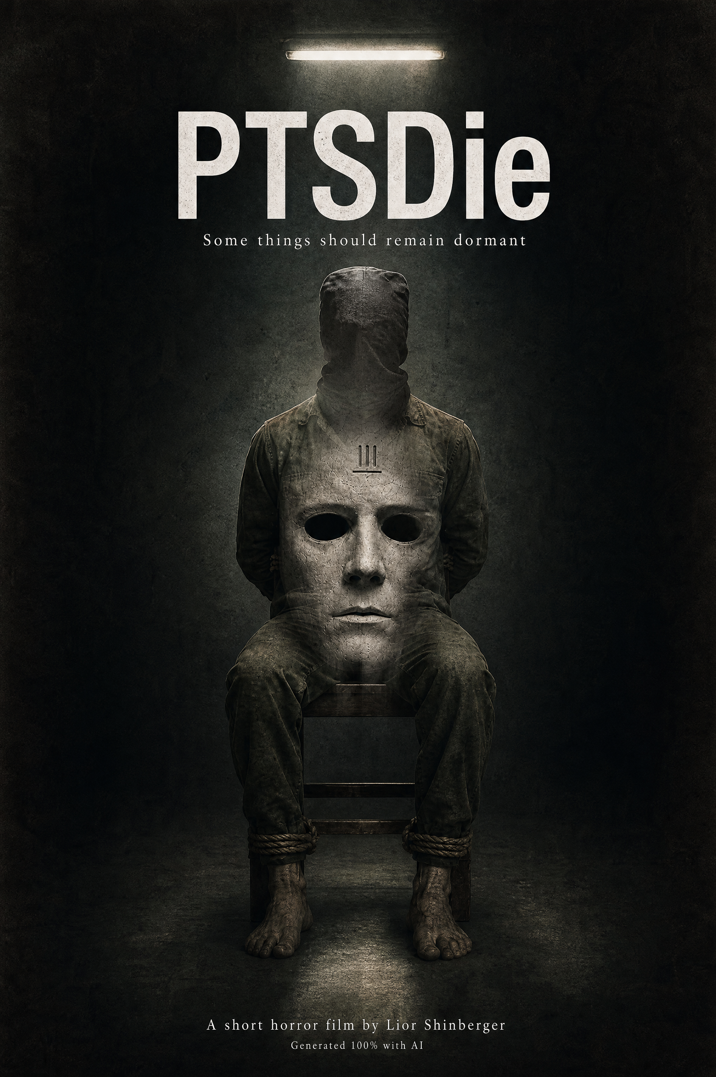
Password-protected. For festival programmers and press.
SYNOPSIS
Brian, a young man in his early thirties, is drifting through another sleepless night — clicking from one random webcam-chat room to the next — when he lands on a live feed he can't scroll past. A masked figure stands before the camera. Beside it, bound to a chair, sits a man he doesn't recognize. The figure lifts a sign to the screen: "If you skip, he will die."
Whatever Brian chooses in that moment sets the rules of the game — and from there, there is no going back. As the night wears on, the edges of the screen begin to blur, and what looked like one stranger's cruel game reveals itself as something far more personal.
PTSDie was created entirely with AI tools. Beneath its horror runs a sharp indictment of how our society is failing to provide the right solutions for those who are struggling with invisible wounds.
DIRECTOR'S STATEMENT
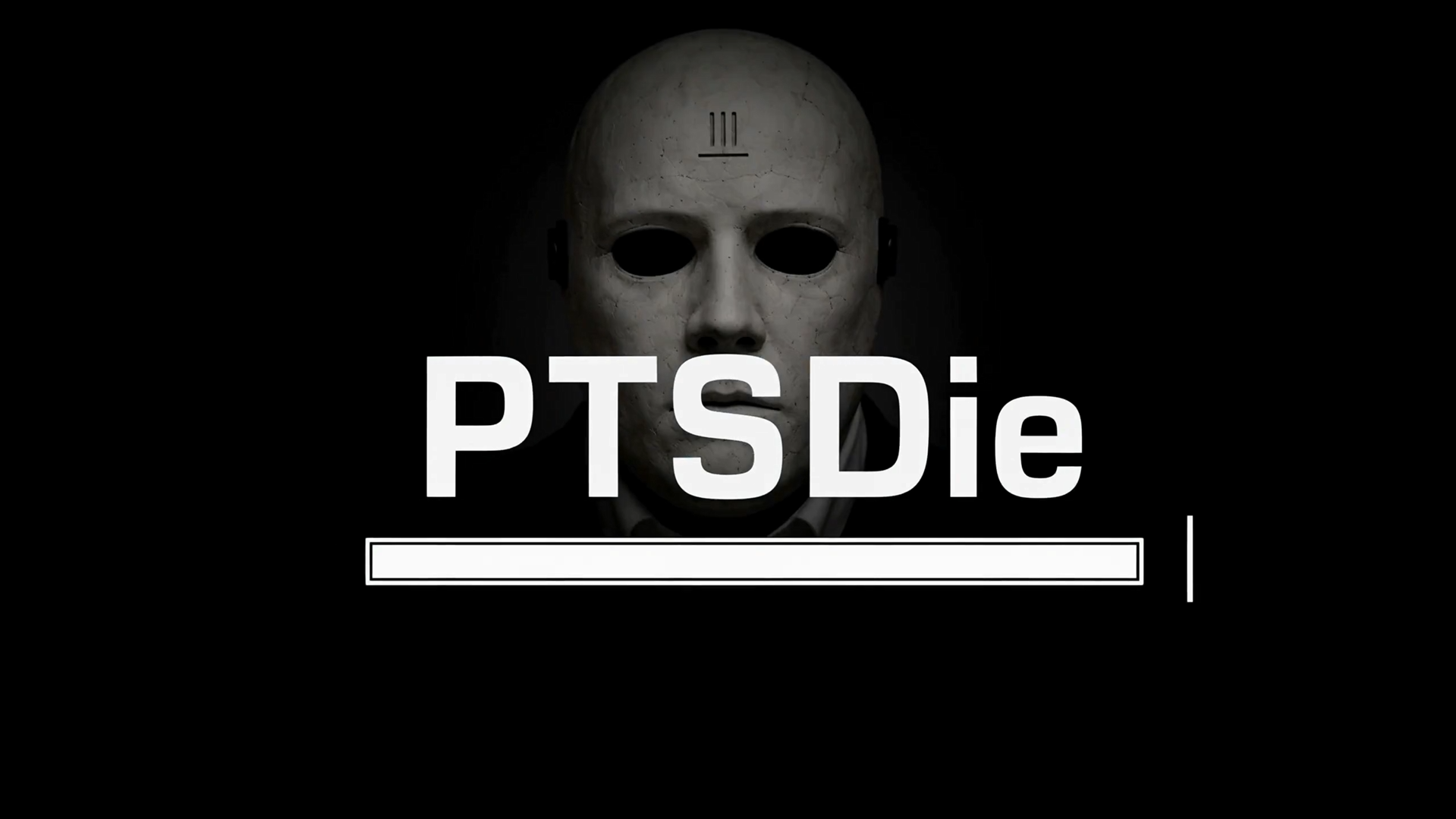
Post-trauma is a global condition. Across the world, its lifetime prevalence in the general population sits near 3.9%, climbing to 5.6% among those who have been exposed to trauma — and researchers note it runs especially high in regions shaped by conflict and combat.1 For those who served, the gap is starker still: the U.S. Department of Veterans Affairs estimates that between 11% and 20% of veterans of the Iraq and Afghanistan wars live with PTSD in any given year — far above the civilian rate.2 As a writer and creator who lives with post-trauma myself, I needed to hand the viewer even a fraction of what it costs to carry an invisible wound — to be asked, again and again, to prove that what happened on the battlefield was real, when every act of digging back into the trauma only tears it open once more. For the first time, the AI tools available today let me deliver — through a story that is entirely fictional — a real indictment of the government and medical institutions that treat the traumatized as one more cog in the machine, and in doing so keep deepening the wound instead of healing it.
PTSDie is not just another horror film. It is a piece of social criticism — one I can only hope reaches enough pairs of eyes to change the way we care for soldiers who came home carrying a wound no one can see. The film was created entirely with AI tools. The script is my own original work, and it offers a glimpse into my world — as a creator, as a director, and as someone who lives with an invisible wound every single day.
1 WHO World Mental Health Surveys — cross-national lifetime PTSD prevalence 3.9% (5.6% among trauma-exposed).
2 U.S. Department of Veterans Affairs — 11–20% of Iraq/Afghanistan veterans experience PTSD in a given year.
STILLS
CREDITS
- Written, Directed and Edited by—Lior Shinberger
- SFX—Audio-1
- Voices—ElevenLabs
- Soundtrack—Suno
- Edited on—CapCut
- Storyboard & Image Generation—GPT-2, Flux
- Video Generation—Seedance 2, Kling 3, Minimax H3
- Generated on—Magnific & Higgsfield